

Even a small hyper-technical error can mean starting over. Consult with a lawyer first.

While commercial landlord-tenant law has not seen the overhaul that residential landlord-tenant law has, the legal/political climate has changed, and some local laws impact commercial cases as well. We regularly handle commercial landlord-tenant disputes.
We represent both commercial tenants and landlords throughout the Puget Sound area.
This typically applies where friends or family reside in the owner's property free of rent obligations.

Our practice also includes commercial landlord‑tenant disputes, representing businesses on both sides of the lease when conflicts arise.
Washington Landlord-Tenant Attorney
At Eller Law Firm PLLC, attorney Travis Scott Eller Washington focuses on Washington landlord‑tenant law, helping landlords navigate an increasingly complex and evolving legal landscape.
For more than two decades, he has seen every shift in landlord-tenant law and is in the trenches every day. He has successfully litigated landlord-tenant and eviction cases through every phase and facet: representing commercial and residential landlords in evictions; defending landlords against claims and lawsuits; litigating through civil trials, arbitations, and appeals.
Mr. Eller presents frequently at bar-approved continuing legal education seminars on landlord-tenant law. He has spoken on landlord-tenant law for landlord industry groups and for the King County Law Library and authored works on landlord-tenant law available at the King County Law Library and the Pierce County Law Library. He scored in the 96th percentile on the Law School Admissions Test, was invited to apply by his law school of choice, was awarded a merit-based scholarship, and later earned the National Institute for Trial Advocacy's "Advocate" designation.
Recent Speaking Engagements
• 2026 Landlord-Tenant Law Updates CLE (WSBA, May 27, 2026)
• Residential Evictions CLE (The Seminar Group, April 2026)
• Landlord‑Tenant Q&A Session (King County Law Library, March 2026)
• Residential Evictions CLE (The Seminar Group, March 2025)
• Landlord‑Tenant Q&A Session (King County Law Library, June 2025)
• Washington Landlord‑Tenant Law 2024 CLE — Presenter (National Business Institute, October 2024)

Call 206-801-1188
or Click the Contact Us Button
Landlord-Tenant Law FAQs
Certified mail is no longer required for predicate notices (pay or vacate, etc.) unless required by the terms of a lease. Note that mailing alone, even if received by the tenant, is not legally valid service of a notice. For a summary of service rules for predicate notices, see our Serving Eviction Notices page.
Drafting and service of notices was straightforward in the past, but is now nuanced. Landlords are encouraged to seek legal advice before proceeding.
Auburn repealed its local just cause eviction law. Auburn still requires landlords to have a business license (although the law explicitly making this requirement a defense to eviction was also repealed).
Landlords must still comply with state good cause eviction laws.
Both. Local rent increase laws still apply. Note that if state and local law allow a different rent increase, the landlord can only increase by the lower amount.
The City of Tacoma is considering a bill that would roll back some local landlord-tenant laws, including the two rent increase notices currently required in addition to the state rent increase notice. The Tacoma proposal has not been enacted at the time of this FAQ posting.
Possibly.
The new rent control law can be read in different ways. One interpretation is that any pending rent increase is void, and a new rent increase notice must be served that complies with the 90-day notice requirement, uses of mandatory form language, and is served per the new statute on serving tenant notices.
All this is far too nuanced for a quick explanation. It is best to consult with an attorney.
Yes, King County has mandatory notice forms for terminating tenancies in unincorporated King County. Proper use of these forms is not simple. Landlords are encouraged to consult with an attorney before serving any notices for unincorporated King County rental properties.
The federal CARES Act requires a 30-day notice to vacate for covered properties for nonpayment of rent.
The CARES Act will apply if the property has a federally-backed loan (Fannie Mae, FHA, Freddie Mac, etc) or if the rental unit has a Section 8 tenant.
Tenant attorneys may also argue that the CARES Act applies if the landlord has ever had a mortgage forbearance under federal law, or if there are Section 8 tenants in any of the units in the rental property–even if not the rental unit at issue in the eviction case, and in various other situations. These situations present unresolved, open legal questions for which there is currently no definitive answer.
The CARES Act is just one example of how nuanced and complex eviction law has become. If you are having issues with a tenant and considering eviction, you are strongly encouraged to consult with an attorney.
While there may be forms on the internet, landlord-tenant law is nuanced and complicated. Drafting and serving notices without the assistance of an attorney is not recommended.
How to calculate the 90-day period is not always cut-and-dried. The Court of Appeals has ruled that the owner may not enter into a purchase and sale agreement and still enforce the notice of intent to sell. Meanwhile, some local laws require listing before serving the notice of intent to sell.
Landlords are strongly encouraged to retain an attorney, including for the initial notices.
Also, a generic form may not be legally effective in all local jurisdictions. Some local laws require longer notice periods than state law and/or require specific additional mandatory language. Some local jurisdictions have mandatory eviction notice forms that landlords must use.
Always seek the advice of an attorney before taking any actions that may affect your rights.
Yes, but you will have to give the greater of 90 days or through the end of the lease terms as the date of termination of the tenancy. An owner can sell or move into their property, but if a tenant has an unexpired lease the owner cannot insist the tenant vacate early. The tenant has a contract through the end of the lease term and does not have to vacate until the end of the term.
The owner would have to sell with the tenant in the tenant unless the parties reach a mutual early termination agreement. Any early termination agreement must give the tenant at least 60 days to vacate.
Yes, the language matters and the court may dismiss your eviction case on procedural grounds–no matter how deserving on the merits–if the language is wrong.
Some documents, such as the 14-day notice, must be in the exact verbiage required by statute. In some local jurisdictions additional specific language must be in the notice and/or additional documents must be served with it.
There are some multi-state websites that show up in Google results with form generators that create notice forms that will not hold up in Washington courts. We do not post forms for every situation or jurisdiction because the new laws vary and are not simple to implement. Consult with an attorney before serving documents.
Proper service of an eviction notice (pay rent or vacate, or etc.) requires someone to go to the rental property and knock on the door. While there are detailed instructions on serving eviction notices on this website, it is far wiser to have an attorney advise and assist with every step in the process.
It makes no difference whether the agreement was reduced to writing, or was only an oral agreement. If someone is paying you (or is supposed to pay you) to live in your property, you are a landlord and they are a tenant. All the eviction and landlord-tenant laws apply.
Ironically, in some situations it may be faster to evict a tenant than someone who lives in your property without an obligation to pay.
Temporary Washington Wildfire Rental-Housing Rules
Governor Ferguson’s Emergency Proclamation 26-03.1, issued August 10, 2026, temporarily restricts execution of most residential eviction orders in Chelan, Douglas, Ferry, Okanogan, Spokane, Stevens, and Yakima Counties, and on certain identified tribal lands, through August 24, 2026. It also temporarily protects tenants in those areas from having a wildfire-related absence treated as abandonment through August 31, 2026.
A narrower rule applies statewide through August 31, 2026: landlords may not use a vacancy-related notice based on a tenant’s housing of a person—or that person’s pet—displaced from an identified wildfire area. This protection does not apply generally to all unauthorized occupants or pets. Outside the identified wildfire areas, ordinary eviction matters are generally unaffected unless they are based on housing a wildfire-displaced person or pet.
This summary provides general information only and is not legal advice. The proclamation’s application depends on the property location, eviction ground, and case posture.

Call 206-801-1188
or Click the Contact Us Button
FAQs About Our Law Firm
Yes. We have successfully handled eviction cases on appeal. There are far more eviction cases being appealed today than in the past. Contact our office about consultation, referral, or association.
Yes. Our office represents both commercial landlords and commercial tenants in all manner of disputes including evictions and civil lawsuits.
Our office represents only landlords in residential cases. Residential tenants are encouraged to Google the Housing Justice Project and/or the Northwest Justice Project.
In commercial cases, we represent tenants as well as landlords.
Yes. We handle a volume of residential landlord cases including evictions, fair housing complaints, and defending against claims from former tenants.
Yes. Our office has successfully litigated disputes over industrial equipment valued in the hundreds of thousands of dollars and commercial leasing disputes involving many tens of thousands of dollars, for example. Contact our office if you have a small business dispute.
206-801-1188
Home Page
Seattle Residential Landlords Must Register Rental Properties
August 22, 2026Travis Eller to Present at WSBA Landlord‑Tenant Law Update CLE
April 9, 2026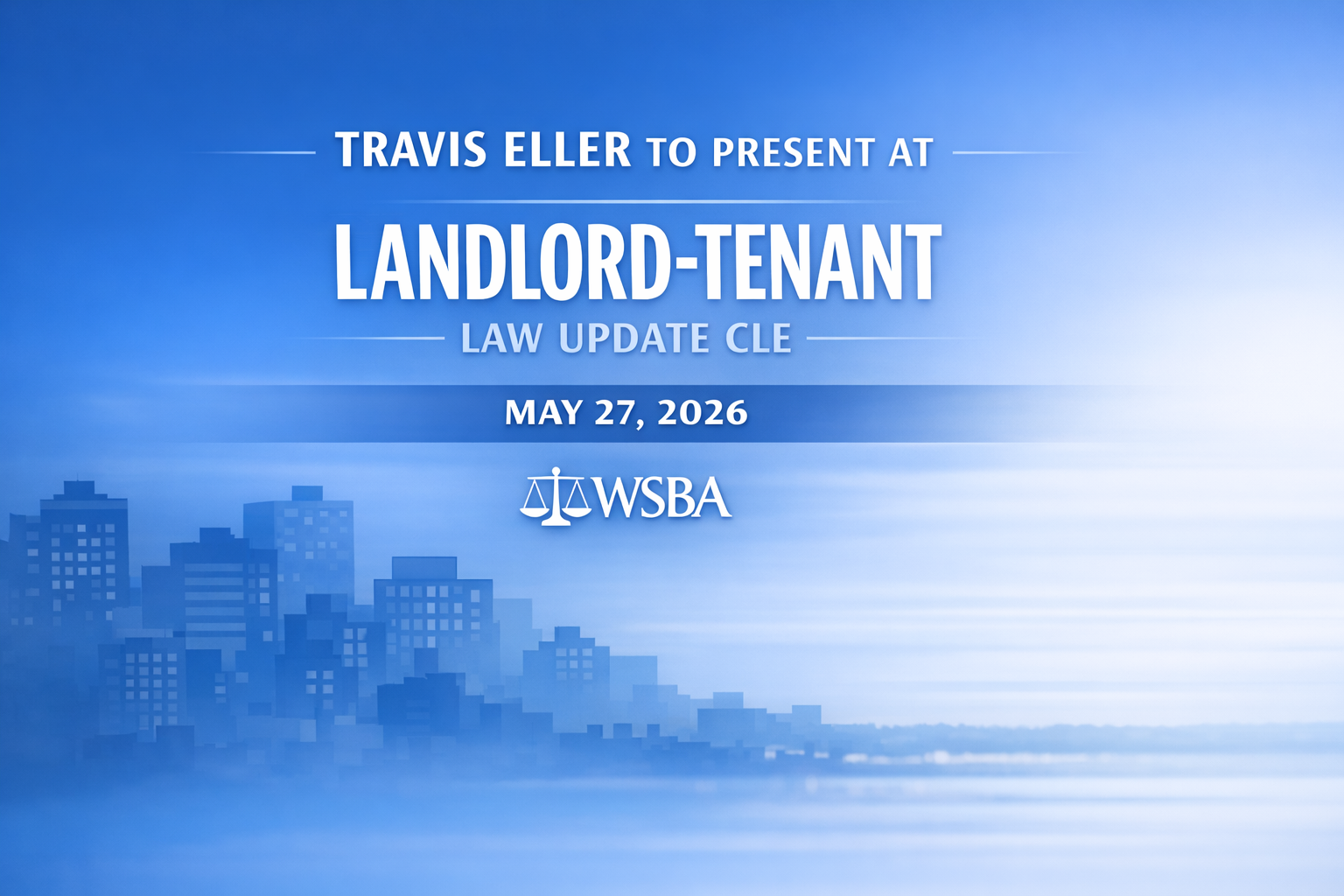
Washington to Eliminate Certified‑Mail Requirement for Eviction Notices (Effective June 11, 2026)
March 15, 2026
Travis Eller at King County Law Library Q&A Session
February 26, 2026
Attorney Travis Scott Eller to Chair Seminar
January 31, 2026Egbert: Court Of Appeals Clarifies Show Cause Hearing Process
December 21, 2025